The first carbon footprint assessment of the salon du livre de Genève
To better understand and reduce its environmental impact, in 2025 Palexpo undertook a full carbon assessment of the Geneva Book Fair, which it organises. The assessment covered the entire event cycle, from set-up to dismantling, and included both direct and indirect emissions. Conducted using ADEME’s Bilan Carbone® methodology, the study aimed to provide a detailed analysis of emissions in order to identify the main areas for action and prioritise reduction measures.
A controlled overall footprint, revealing sector-wide challenges
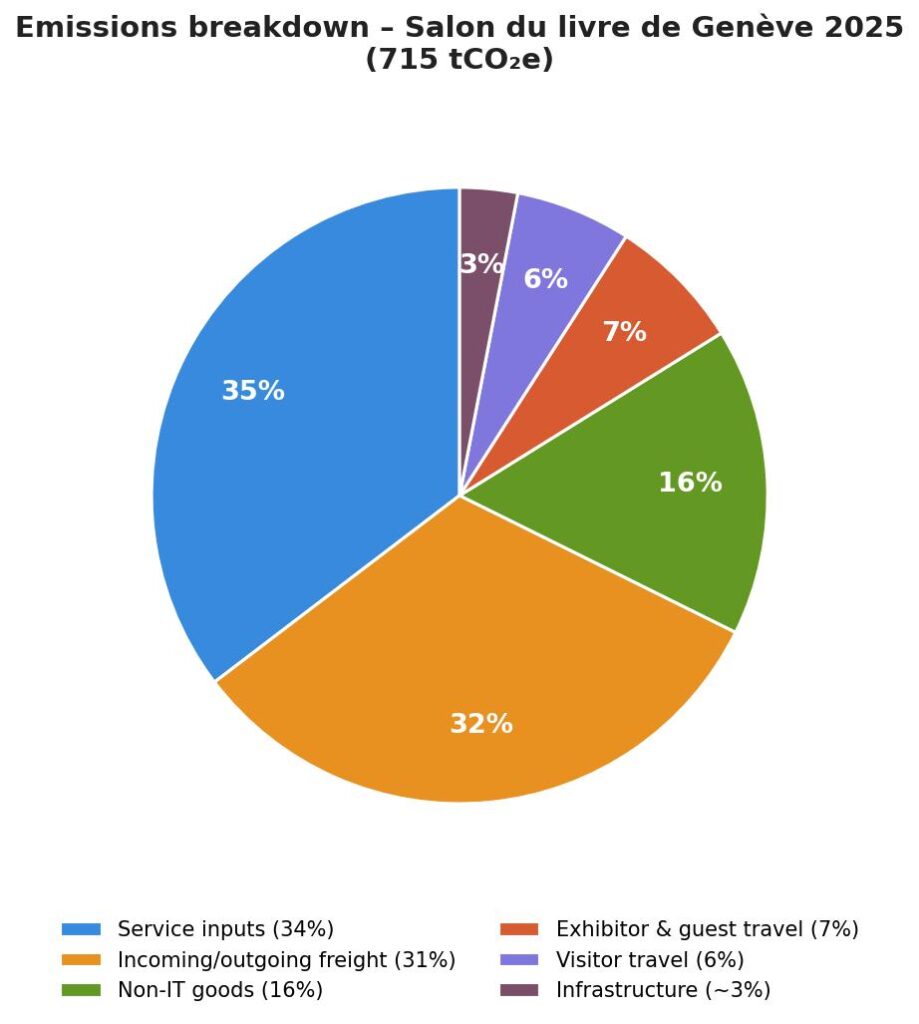
The 2025 edition of the Geneva Book Fair generated 715 tonnes of CO₂ equivalent, or around 12 kg of CO₂ per participant, a level comparable to major international cultural fairs. The analysis highlights a structural reality for the entire event sector: the majority of emissions do not stem from the operation of the venue itself, but from its ecosystem. The main sources identified were as follows:
✧ Purchased services (34%): service delivery, stands, security, catering and communications
✧ Inbound and outbound freight (31%): transport of goods and equipment
✧ Other goods excluding IT equipment (16%): furniture, signage, catering and accommodation
These three categories alone account for almost 80% of the event’s total carbon footprint.
Mobility: a real but contained impact
Travel is another area of focus:
- Exhibitor and guest travel: 7%
- Visitor travel: 6%
While the arrival of some guests by air weighs significantly, the high proportion of regional visitors and the site’s accessibility by public transport help contain the overall impact.
Infrastructure: a limited carbon contribution
By contrast, emissions linked to the direct operation of the venue, such as energy, waste and commuting, remain marginal, at around 1% per item. This confirms the performance of the infrastructure and operational systems in place.

Key strategic insights for the future
Beyond the diagnosis itself, this assessment provides a strategic foundation for guiding future action. In particular, it highlights three priority levers: eco-design and optimised purchasing, logistics and freight transport, and support for low-carbon mobility. These are workstreams that involve the entire event value chain – organisers, exhibitors, service providers and partners – and in which Palexpo intends to continue playing a driving role.